Whitechapel and the inner city
Housing and overcrowding
Whitechapel is in the East End of London, just outside the City. In the late 19th century it was one of the poorest and most overcrowded parts of London.
- : slum areas of narrow alleys and courts, full of crumbling, damp houses. Whole families often lived in one room.
- Poor drainage and water supplies spread disease.
- : thousands of people with no home of their own paid a few pence a night for a bed in a shared room. If they could not pay, they had to sleep on the streets.
Exam tip
For 'Describe one feature of housing in Whitechapel', give the feature and a detail: 'Many people lived in common lodging houses. They paid a few pence a night for a bed in a crowded shared room.'
Key terms
Attempts to improve housing, and the workhouses
The Peabody Estate: the allowed slum areas to be bought and cleared. In Whitechapel, slums near Royal Mint Street were cleared, and the , a charity set up by the American banker George Peabody, built an estate of clean, healthy flats, which opened in 1881. But rents were too high for the poorest people, who moved to other overcrowded streets.
people who could not support themselves at all could go into the Whitechapel workhouse. Conditions were deliberately harsh, families were separated, and inmates had to do hard, boring work. People saw it as a last resort.
Key terms
Work, poverty and a shifting population
- Lack of work: many men relied on casual work, such as at the docks, where they were hired by the day and could never be sure of work. Others worked long hours for low pay in small workshops called , making clothes, boots or furniture.
- Poverty: Charles Booth's survey of London, in the late 1880s, found that a large share of East London's people lived in poverty.
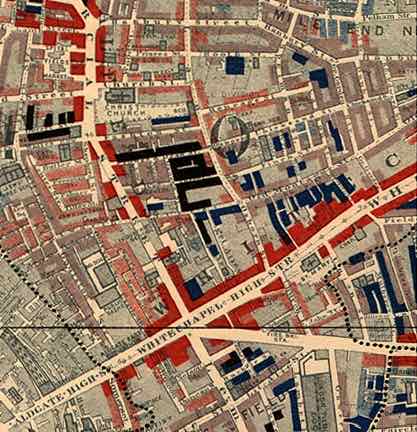
Booth coloured each street by the class of the people living there: black for the poorest, dark and light blue for the very poor and the poor, purple for mixed streets, pink for the fairly comfortable, red for the middle class and yellow for the wealthy.
- A shifting population: many people moved between lodging houses, and spent their time in the area's many pubs. They had no ties to the community, which made crime harder to prevent and solve.
Key terms
Migration
Irish migrants had come to Whitechapel since the 1840s, many working at the docks. They faced prejudice, which increased in the 1880s when Irish nationalists carried out bombings in Britain.
In the 1880s, there was a large increase in Jewish migration from Eastern Europe, especially from the Russian Empire, where Jewish people were being attacked in violent riots called . Many settled in Whitechapel, and worked in tailoring and other trades.
Jewish migrants faced . Some people blamed them for overcrowding and low wages, and newspapers often described them in hostile, prejudiced ways. During the murders of 1888, there were attacks on Jewish people.
Key terms
Links between the environment and crime
Cause: Whitechapel's conditions helped crime to grow:
- Poverty led some people to theft, and some women to prostitution to survive.
- Alcohol: drunkenness led to violence.
- Dark, narrow alleys and courts made it easy for criminals to escape, and hard for police to patrol.
- A shifting population meant few people knew each other, so witnesses were rare.
Charles Booth described the area like this:
('Tom Tiddler's ground' and 'Eldorado' both mean a place where people hope to find money easily; 'buffoonery' means clowning.)