Investigating the Whitechapel murders
The murders, 1888
Between August and November 1888, five women were murdered in and near Whitechapel. They were:
| Victim | Date |
|---|---|
| Mary Ann Nichols | 31 August |
| Annie Chapman | 8 September |
| Elizabeth Stride | 30 September |
| Catherine Eddowes | 30 September |
| Mary Jane Kelly | 9 November |
All five were poor women who lived in the area, and several stayed in its lodging houses. Their killer was never caught, and became known as 'Jack the Ripper'. Remember that these were real women, whose lives were shaped by the poverty of Whitechapel.
Key terms
Investigating the murders
The police used the methods they had:
- Interviews: detectives questioned witnesses, lodging-house residents and suspects, and searched houses door to door.
- Sketches: drawings were made of the crime scenes and of suspects described by witnesses.
- Photographs: victims were photographed, and in one case the crime scene too, which was new.
- Detectives were sent from Scotland Yard, including Inspector Frederick Abberline, who knew the area well.
Limits: there were no fingerprint records until 1901, and no way to match blood or other traces to a person. Witnesses' descriptions often disagreed.
Exam tip
This unit is about policing, not about who the murderer was. Focus answers on the investigation and its problems, not on theories about the killer.
Key terms
Problems of cooperation
Three police organisations were involved:
- of the Metropolitan Police, which policed Whitechapel
- , which sent detectives
- the separate , because Catherine Eddowes was killed in Mitre Square, inside the City.
Problems: the forces did not always share information, and sometimes competed with each other. Different forces used different approaches, and there were disagreements between police leaders. On one occasion, Warren had a chalk message near a murder scene rubbed out before it could be photographed, fearing it would cause attacks on Jewish people.
Key terms
The media and the 'Ripper letters'
Cheap newspapers were read by millions, and the murders sold papers.
- Newspapers printed sensational reports, rumours and theories, and strongly criticised the police.
- were sent to the police and the press claiming to be from the killer. One, the 'Dear Boss' letter, first used the name 'Jack the Ripper'. Most were hoaxes.
Consequences: the letters and false leads wasted police time, the reports spread panic, and the criticism damaged public trust in the police.
Key terms
The Whitechapel Vigilance Committee
In September 1888, local businessmen, led by George Lusk, set up the . Its members patrolled the streets at night, and it offered a reward for information, after the government refused to.
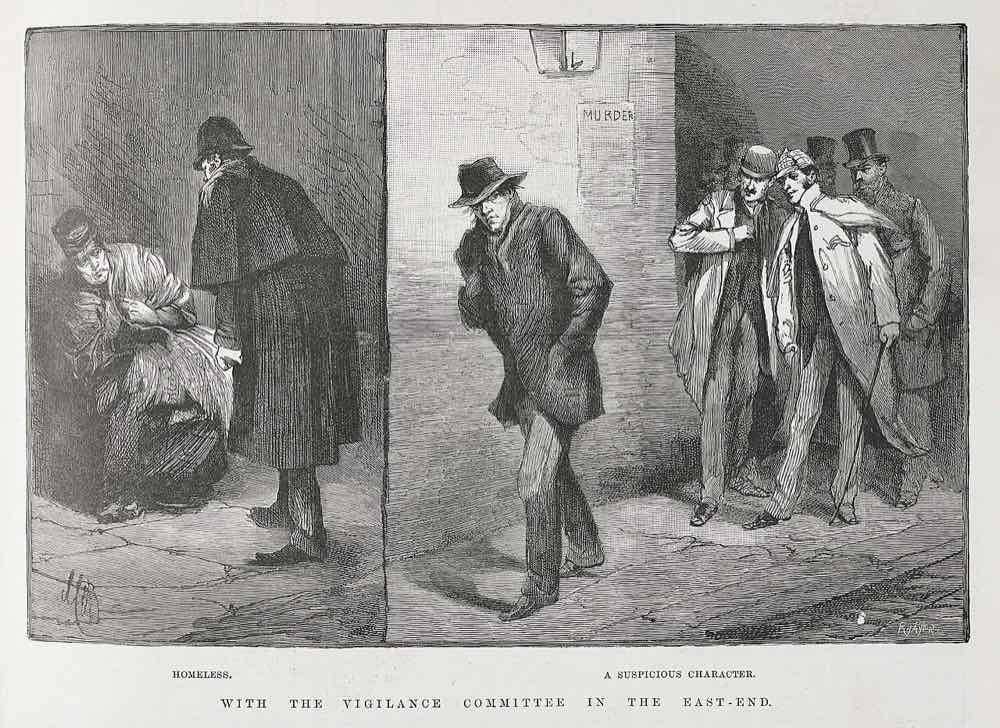
Significance: the committee shows that many local people had lost confidence in the police. But it also shows continuity with the past: the community taking action to fight crime, as with the hue and cry.
Why the case was never solved: limited forensic methods, a shifting population, poor cooperation, and the confusion created by the press and hoax letters.