Edward the Confessor and the succession crisis
The house of Godwin
Godwin, Earl of Wessex, was the most powerful noble in England. In 1045 his daughter Edith married King Edward. In 1051 the Godwins quarrelled with Edward and were sent into exile, but in 1052 they returned with an army, and Edward had to give them back their lands.
When Godwin died in 1053, his son Harold Godwinson became Earl of Wessex. Harold's brothers became earls too: Tostig of Northumbria in 1055, and Gyrth and Leofwine in the east and south-east.
Significance: by the 1060s Harold was the richest and most powerful man in England after the king. He was Edward's chief adviser and war leader, and won a campaign against the Welsh in 1063. That made him the obvious English choice as the next king.
Key terms
Harold's embassy to Normandy
In 1064 or 1065 (historians disagree about the year), Harold sailed across the Channel. Why he went is also disputed. Norman writers say Edward sent him to confirm that William of Normandy would be the next king. Others suggest he went to free relatives held hostage in Normandy.
Harold was shipwrecked in Ponthieu and held by its count, until William had him released. Harold then fought alongside William in Brittany. According to Norman writers and the , Harold swore a solemn oath on holy relics to support William's claim to the English throne. English sources don't mention the oath.
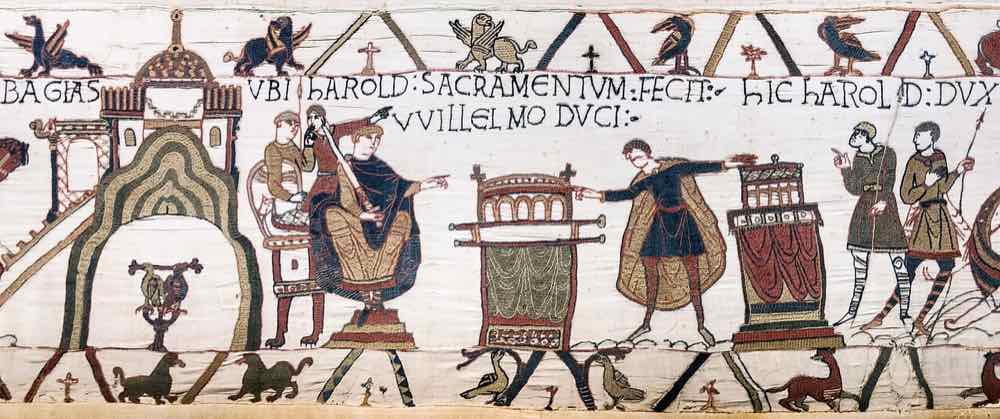
('Ubi Harold sacramentum fecit Willelmo duci' means 'Where Harold made an oath to Duke William'.) The Tapestry shows Harold touching holy relics in front of William. Think about who it was made for, and why a Norman audience would want this scene.
Significance: when Harold took the crown, William could say he had broken a sacred oath. This helped William win the Pope's support for his invasion.
Key terms
The rising against Tostig, 1065
In autumn 1065 the thegns of Northumbria rebelled against their earl, Tostig, Harold's brother. They resented his heavy taxes and harsh rule. They killed his servants in York, declared him an , and chose Morcar, brother of Earl Edwin of Mercia, as their new earl.
Harold met the rebels at Northampton on Edward's behalf, and agreed to their demands. Tostig was exiled, and went to Flanders.
Consequences:
- Harold kept the peace and won the support of Edwin and Morcar. He later married their sister.
- But he turned his own brother into a bitter enemy. In 1066 Tostig raided England and then joined Harald Hardrada's invasion.
Key terms
Edward's death and Harold's coronation
Edward the Confessor died on 5 January 1066, with no children. English sources say that on his deathbed he named Harold as his successor. The agreed, and Harold was crowned in Westminster Abbey on 6 January 1066, the day after Edward died and the day of his funeral.
Cause: the speed suggests Harold and the Witan wanted a strong, experienced king in place before any rival could act.
Harold reigned for only nine months, and spent much of it preparing for invasion. In spring, a comet was seen over England, which many took as a warning. In May, Tostig raided the south and east coasts.
('Settled the realm on' means 'left the kingdom to'; 'hallowed to king' means 'crowned'.)
Key terms
The rival claimants
Four men had a claim to the throne in 1066:
| Claimant | Who he was | His claim |
|---|---|---|
| Harold Godwinson | Earl of Wessex, Edward's brother-in-law | Named by Edward on his deathbed; chosen by the Witan; experienced leader |
| William of Normandy | Duke of Normandy, Edward's cousin | Said Edward promised him the throne, and Harold swore to support him |
| Harald Hardrada | King of Norway, a famous Viking warrior | An agreement between earlier kings of Norway and England; Tostig's support |
| Edward's great-nephew, a teenager | The closest blood relative of Edward |
Significance: Edgar had the best claim by birth, but no army and few supporters. The others all had armies, so 1066 would be decided by fighting.
Common mistake
Don't mix up Harold Godwinson, the English earl and king, with Harald Hardrada, King of Norway.