The battles of 1066
1066 in order
| Date (1066) | Event |
|---|---|
| 5 January | Edward the Confessor dies |
| 6 January | Harold Godwinson is crowned |
| Summer | Harold waits on the south coast with his fleet and the fyrd |
| 8 September | The fyrd is sent home, its food used up |
| September | Harald Hardrada and Tostig land in the north |
| 20 September | Battle of Gate Fulford |
| 25 September | Battle of Stamford Bridge |
| 28 September | William lands at Pevensey |
| 14 October | Battle of Hastings |
| 25 December | William is crowned |
Remember
Fulford, Stamford Bridge, Hastings: two battles in the north, then one in the south, all within four weeks.
Gate Fulford and Stamford Bridge
In September, Harald Hardrada and Tostig sailed up the River Ouse towards York. On 20 September they defeated Earls Edwin and Morcar at Gate Fulford, just outside York.
Harold marched north with his housecarls very quickly, and on 25 September took the Norwegians by surprise at Stamford Bridge. Hardrada and Tostig were both killed. So many Norwegians died that the survivors needed only 24 ships to go home.
Significance:
- Harold had defeated one rival claimant and his brother Tostig.
- But he had lost many of his best soldiers, and the armies of Edwin and Morcar were badly weakened at Fulford.
- He was far to the north when William landed at Pevensey on 28 September.
The armies at Hastings
| English | Normans | |
|---|---|---|
| Leader | King Harold | Duke William |
| Soldiers | Housecarls and the fyrd, all on foot | Knights on horseback (cavalry), foot soldiers, archers and crossbowmen |
| Weapons | Two-handed axes, swords, spears and round shields | Lances, swords, bows and kite-shaped shields |
| Position | On top of a ridge, in a | At the bottom of the slope |
The armies were probably of a similar size, perhaps several thousand men each, but historians' estimates vary.
Difference: William's mixed army could attack in different ways. Harold's army relied on one strong defensive tactic, the shield wall.
Key terms
The Battle of Hastings, 14 October 1066
The battle lasted most of the day, which was unusually long.
- Norman archers fired, then foot soldiers and cavalry charged uphill. They could not break the shield wall.
- Bretons on William's left fled. Some English broke ranks to chase them downhill and were cut down. A rumour spread that William was dead, so he lifted his helmet to show his face and rally his men.
- Norman writers say William then used : his cavalry pretended to flee, drew more English off the ridge, then turned and killed them. Some historians doubt these were planned.
- The shield wall grew thinner. Late in the day Harold was killed, along with his brothers Gyrth and Leofwine. Exactly how Harold died is unclear. The English then fled.
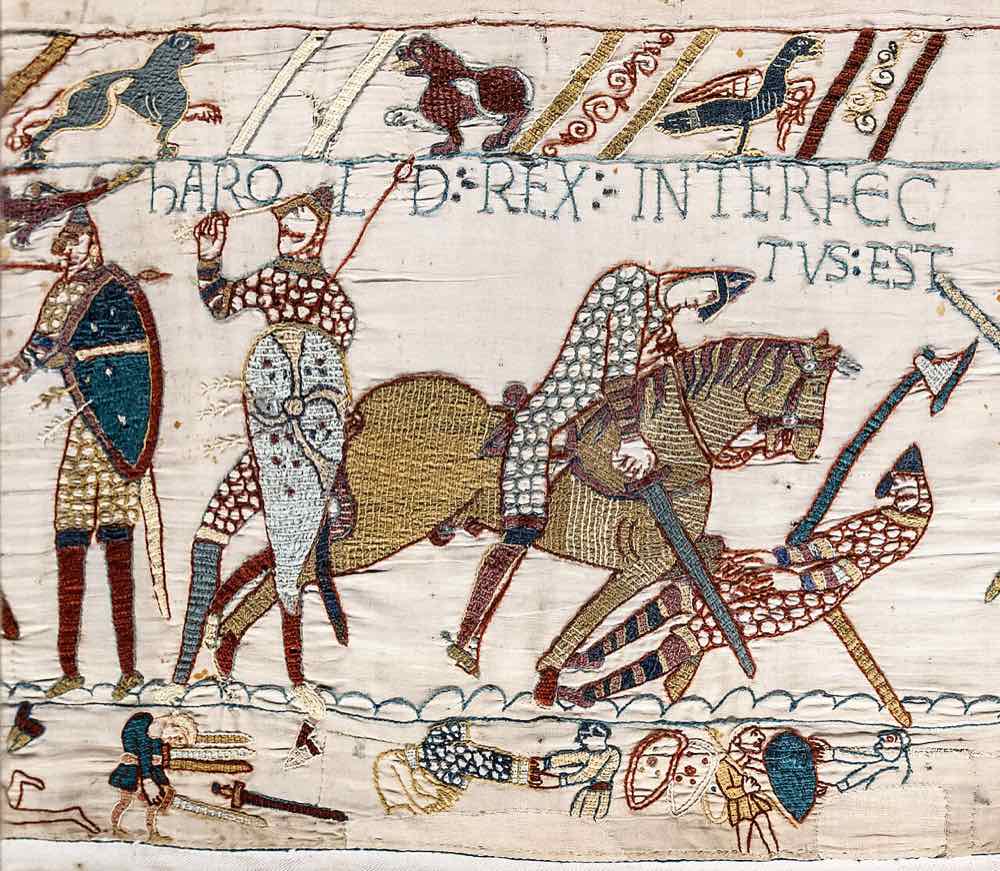
('Harold rex interfectus est' means 'King Harold is killed'.) The words run above two figures: one with what may be an arrow near his face, and one being cut down by a horseman. The Tapestry doesn't make clear which is Harold, or whether both are. This is one reason historians disagree about how he died.
Key terms
What the English chronicle says
('Ere' means 'before'.) The monk blames Harold's lack of soldiers, and sees the defeat as God's punishment of the English. Both ideas are useful evidence of how English people explained the Conquest.
Why William won
Historians usually group the reasons like this:
| William's strengths | Harold's mistakes | Luck |
|---|---|---|
| Careful planning, a large fleet and a mixed army | Fought before his whole army had gathered | Winds delayed William, so Harold had to fight Hardrada first |
| Cavalry, archers and feigned retreats | His men broke ranks to chase the Normans | William landed unopposed: the fyrd had gone home |
| Strong leadership and the Pope's support | His army was tired after Stamford Bridge | Harold and his brothers were all killed |
Cause: historians weigh these differently. Many argue Harold's death decided the battle, because it ended English resistance on the field.
Exam tip
In a 'How far do you agree?' question about the main reason for William's victory, explain the stated reason, then at least one other, and finish with a judgement saying which mattered most and why.